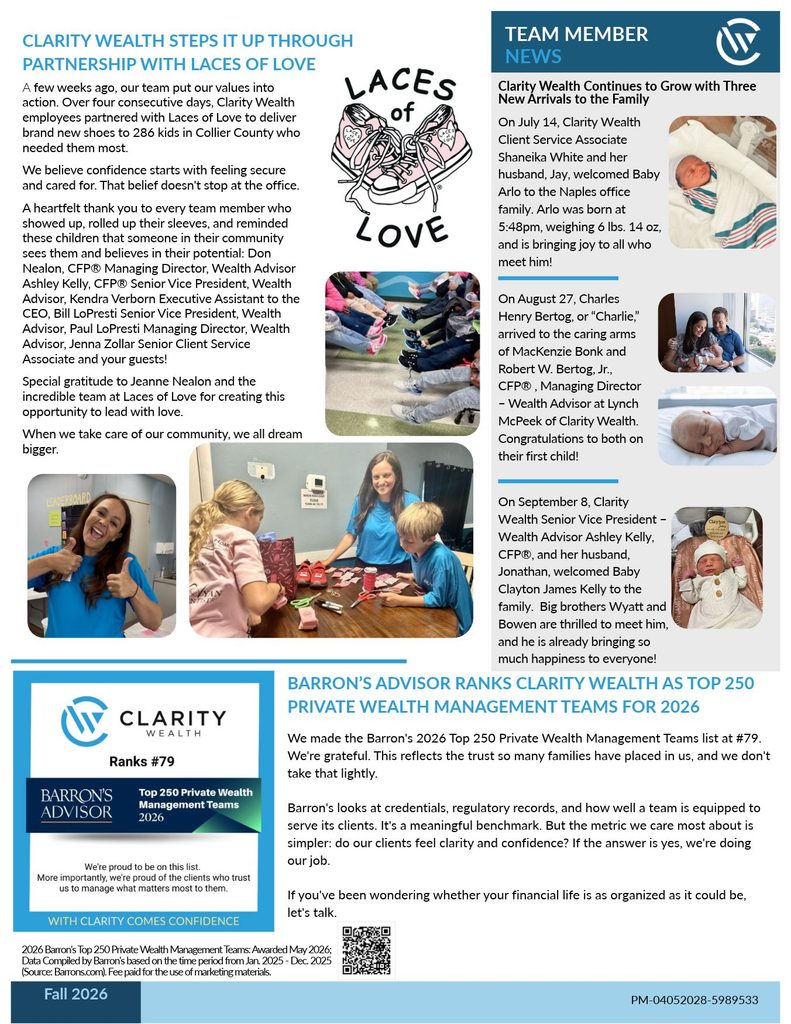

Fall 2026 Newsletter
December 31 arrives faster than most people plan for.
Our Fall 2026 newsletter is here, and it’s all about the Q4 Advantage: coordinating tax, giving, and legacy decisions while there’s still time to make them deliberately.
Inside:
- Turning required withdrawals into charitable impact
- Why more families are choosing donor-advised funds
- Three new faces joining our team
- 286 pairs of new shoes for Collier County kids, delivered with our friends at Laces of Love
The Q4 Advantage: Why Coordinating Tax, Giving, and Legacy Matters
Fourth quarter has a way of speeding up.
The kids go back to school, the holidays land on the calendar, and December 31 arrives sooner than most people plan for. For families managing significant wealth, that deadline carries real weight. The moves you make, or skip, between now and year end can shape your tax bill, your giving, and the legacy you leave behind. At Clarity Wealth, we call this window the Q4 Advantage. It is not about scrambling in December. It is about coordinating your wealth planning early enough to make deliberate decisions instead of reactive ones. Our 3 Altitudes of Planning framework exists for exactly this reason. It helps you rise above any single account or deadline and see how tax strategy, giving, and legacy planning work together as one coordinated system, not three separate to-do lists. Continue reading to see how that coordination pays off this autumn.
The Q4 Advantage
Tax: Turn required withdrawals into a strategy
If you are 73 or older, you are familiar with how the IRS requires you to make Required Minimum Distributions (RMDs) from your traditional retirement accounts each year. Miss it, and the penalty can reach 25 percent of the shortfall. If you were born in 1960 or later, your required beginning age moves to 75 under the SECURE 2.0 Act.
For clients who are charitably inclined, this requirement can become an opportunity. A Qualified Charitable Distribution sends money directly from your IRA to a qualified charity. It counts toward your required withdrawal, but it never touches your taxable income. For 2026, you can direct up to $111,000 this way, or $222,000 for a married couple with separate IRAs. That is real leverage: your giving satisfies a requirement and keeps your adjusted gross income lower, which can also help keep Medicare premiums and other income-based thresholds in check.
Giving: Make generosity efficient, not just generous
Whether you are funding a donor-advised fund, supporting a favorite cause, or helping the next generation get established, timing matters. Gifts made before December 31 count for this tax year. Gifts made on January 1 do not. The annual gift tax exclusion for 2026 lets you give up to $19,000 to any number of people without filing a gift tax return or touching your lifetime exemption. Married couples who elect to split gifts can give $38,000 per recipient. Used consistently, we believe this is one of the simplest, most efficient tools for moving wealth to the people and causes you care about, while you are here to see the impact.
Legacy: Preserve what you have built
The federal estate and gift tax exemption rose to $15 million per individual for 2026, meaning a married couple can shield up to $30 million from federal estate tax. That is real headroom for most families, but headroom is not the same as a plan. Trusts, beneficiary designations, and the ownership structure of your assets all need to work together with your tax and giving strategy, not sit in separate binders.
Why now
Every one of these strategies gets harder to execute well in the last week of December. Charities need processing time. Custodians need paperwork. Your CPA needs time to model the impact before, not after, the transaction. Coordinating tax, giving, and legacy decisions in October and November gives everyone involved, including you, the runway to get it right.
Wells Fargo Advisors Financial Network does not provide legal or tax advice.
Sources: IRS, Gifts and Inheritances FAQ, irs.gov:
IRS, What’s New: Estate and Gift Tax, irs.gov:
Charles Schwab, “Reducing RMDs With QCDs in 2026“:
Fidelity, “Qualified Charitable Distributions (QCDs)”:
Kiplinger, “Gift Tax Exclusion for 2026”
Morgan Lewis, “IRS Announces Increased Gift and Estate Tax Exemption Amounts for 2026”:
DONOR-ADVISED FUNDS
The Giving Vehicle That Wealthy Families Actually Choose
Every year, more families are discovering the same tool for their charitable giving: the donor-advised fund. It is not new. It is not flashy. But it has quietly become the most popular giving vehicle in American philanthropy, and there is a good reason why.
Donor-advised funds, or DAFs, now hold more than $327 billion in charitable assets nationwide, a 27.9% jump in a single year. Contributions into DAFs grew even faster, up nearly 39% year over year. Growth in DAF giving is outpacing the growth of charitable giving overall. Families are not just hearing about this tool. They are using it.
So what is a DAF, and why does it fit so naturally into a family’s wealth plan? Think of it as a charitable checking account. You contribute cash, appreciated stock, or other assets to the fund. You get an immediate tax deduction the year you contribute. Then, on your own timeline, you recommend grants to the charities you care about. There is no rush. There is no deadline. The money can sit and grow, invested for further charitable impact, until you decide where it goes. We believe that flexibility is exactly why it resonates with the families we serve, especially those focused on building a legacy that outlasts them.
Here is what makes a DAF worth a conversation with your advisor:
– You separate the tax event from the giving decision. Contribute a highly appreciated stock, contribute it to your DAF, and take the deduction now. Decide which causes to support next year, or in five years, without the pressure of a December 31 deadline.
-You avoid capital gains tax on appreciated assets. Donating stock directly to your DAF, rather than selling it and donating cash, keeps more dollars working for the causes you love.
–You can involve your children or grandchildren.
Many families use their DAF as a hands-on lesson in stewardship, naming successors and reviewing grant decisions together at the kitchen table. It becomes part of the family story, not just a line item on a tax return.
–You keep things simple. One statement, one set of records, one place to see your full giving history. No separate tax filings like a private foundation requires.
–You maintain control without the administrative weight. You are not managing a 501(c)(3). You are recommending grants to one, on your own schedule, with far less overhead than a private foundation.
We believe this is where a DAF earns its place inside a broader wealth plan rather than sitting off to the side as an afterthought. At Clarity Wealth, we look at giving through our 3 Altitudes of Planning framework, because we believe a charitable strategy only works when it is coordinated with your estate plan, your tax picture, and your family’s long-term goals. A DAF can be named as a beneficiary in your estate documents. It can absorb a concentrated stock position before a liquidity event. It can smooth out an unusually high income year. Used well, it becomes one more lever in the plan, not a separate decision made once a year under deadline pressure.
We are not going to tell you a DAF is right for every family. Your CPA and estate attorney should always weigh in on the details specific to your situation. But if you have appreciated assets, a desire to involve the next generation, or simply a wish to give with more intention and less paperwork, it is worth a conversation. That is what the Family Wealth Advantage process is built for: helping you see the full picture, so every decision, including how you give, fits the life you are building. With Clarity Comes Confidence.
Donations are irrevocable charitable gifts. The sponsoring organizations maintaining the fund have ultimate control over how the assets in the fund accounts are
invested and distributed. Donor Advised Funds donors do not receive investment returns. The amount ultimately available to the Donor to make grant recommendations may be more or less than the Donor contributions to the Donor Advised Fund. While annual giving is encouraged, the Donor Advised Fund
should be viewed as a long-term philanthropic program. Tax benefits depend upon your individual circumstances. You should consult your Tax Advisor. While the operations of the Donor Advised Fund and Pooled Income Funds are regulated by the Internal Revenue Service, they are not guaranteed or insured by the United States or any of its agencies or instrumentalities. Contributions are not insured by the FDIC and are not deposits or other obligations of, or guaranteed by, any depository institution. Donor Advised Funds are not registered under federal securities laws, pursuant to exemptions for charitable organizations. Sources Donor Advised Fund Research Collaborative, Annual DAF Report 2025 (FY2024 data, Spring 2026 updated analysis):https://www.dafresearchcollaborative.org/research/annual-daf-report Stelter, Beyond the Record High: What Giving USA 2026 Numbers Reveal: National Philanthropic Trust,
Charitable Giving Statistics (background and historical context, updated February 2026):