
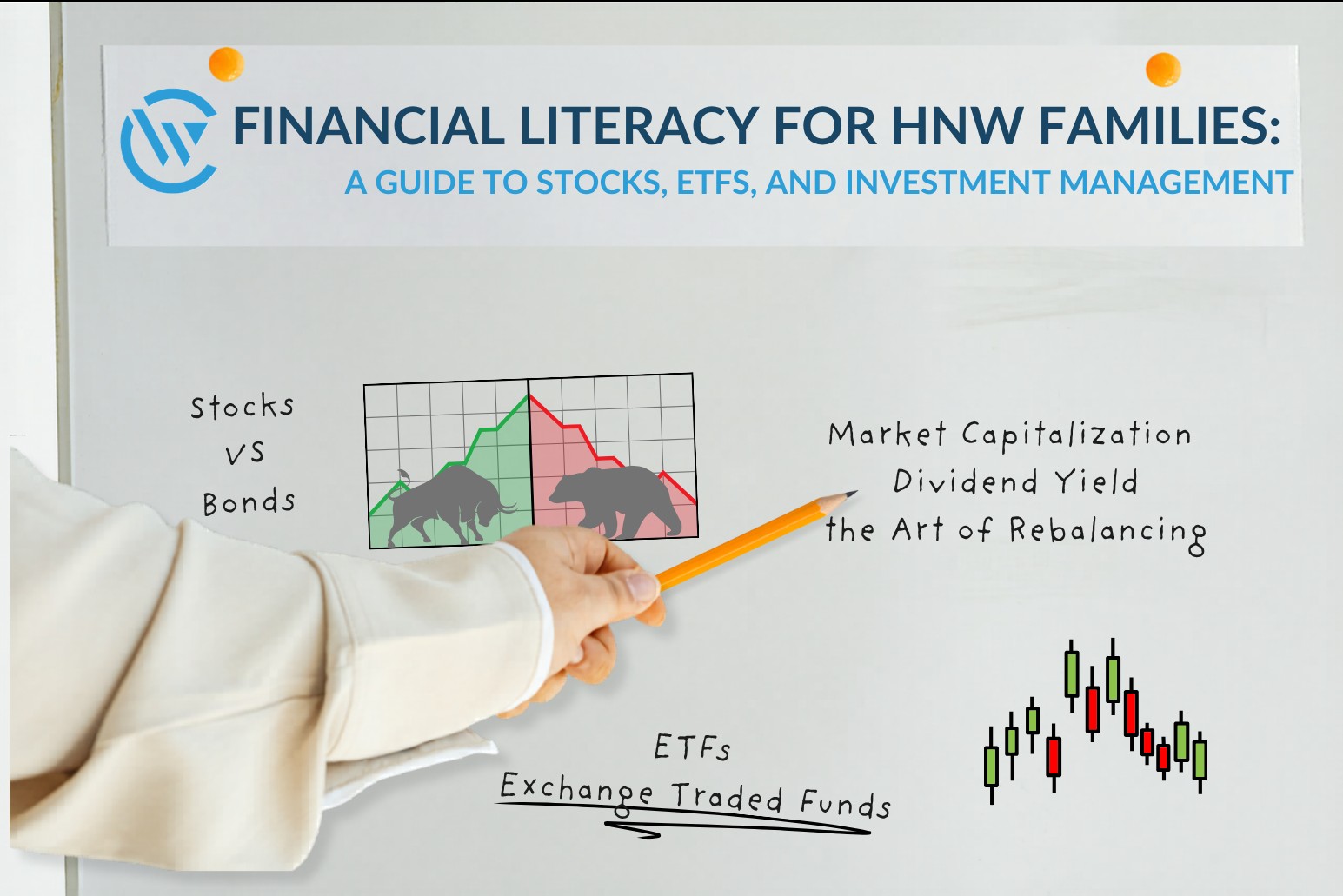
Financial Literacy for High Net Worth (HNW) Families:
A Guide to Stocks, ETFs, and Investment Management
Critical takeaways from the comprehensive guide for high-net-worth families:
- Lifelong Financial Mastery: Financial literacy is a continuous discipline, not a one-time lesson; it is essential for seasoned investors to revisit the basics and for the next generation to start their training early.
- Dynamic Investment Tools: Building wealth requires understanding the different roles of stocks (growth and ownership), mutual funds (professional management), and ETFs (tax efficiency and intraday trading).
- Risk Assessment through Metrics: Investors should use Market Capitalization to categorize company size and volatility, and Dividend Yield to evaluate sustainable income streams.
- Holistic Legacy Planning: True wealth management integrates Customized Asset Management with Estate and Retirement Planning Strategies to ensure your lifestyle is secure and your legacy is protected for future generations.
- Strategic Asset Allocation and Disciplined Rebalancing serve as the architecture of your portfolio, ensuring your investment mix remains perfectly aligned with your long-term risk tolerance and legacy goals regardless of market volatility.
In the sophisticated world of wealth management, there is a common misconception that once a certain level of net worth is achieved, the “basics” no longer apply. In reality, the most successful families and high-net-worth (HNW) individuals are those who treat financial literacy as a lifelong practice. Whether you are managing a mature portfolio or preparing to transition assets to the next generation, a grounded understanding of financial mechanics is the ultimate safeguard against market volatility.
At Clarity Wealth, we believe that organization brings clarity, and with clarity comes confidence. By decluttering the complexities of your financial life, much like organizing a crowded garage, you gain the mental space needed to think creatively and confidently about the future. Because this sense of security is the ultimate foundation for any family, it is never too early to start training the next generation to handle the responsibilities of their legacy.
To help you begin that transition, we have compiled this Finance 101 guide. It serves as a foundational roadmap for your family to master the essential terms and concepts to help manage wealth with logic, discipline, and confidence.
Section 1: The Mechanics of Equity – Understanding Stocks
What are stocks and why do companies issue them?
Stocks, also known as equities or shares, represent a literal ownership stake in a publicly traded corporation. When an investor buys a stock, they become a part-owner, gaining a claim on a portion of the company’s assets and its future earnings.
Companies issue stocks primarily to raise capital. This influx of cash allows them to:
- Expand operations into new markets.
- Develop innovative products.
- Scale their workforce by hiring more employees.
How do investors generate returns from stocks?
There are two primary engines of wealth creation in the stock market:
- Stock Appreciation: As a company’s value increases, the market price of its stock typically follows. If you sell the shares for more than the purchase price, you realize a profit.
- Dividends: Mature companies often distribute a portion of their profits directly to shareholders. These regular payments can provide a consistent income stream, which is particularly valuable for long-term wealth preservation.
What are different types of stocks?
Not all stocks are created equal. Understanding these distinctions is vital for portfolio construction:
- Common Stock: The standard form of ownership, usually providing voting rights and potential dividends.
- Preferred Stock: Offers higher priority for dividends and asset claims during a liquidation, though typically without voting rights.
- Growth Stocks: Companies expected to grow at an above-average rate. They rarely pay dividends, instead reinvesting all profits back into the business to fuel further expansion.
- Value Stocks: These are stocks that appear undervalued by the market relative to their fundamentals (like earnings or sales). Investors buy them expecting a future price correction or “rebound”.
Section 2: Diversification via Mutual Funds
What is a Mutual Fund?
A mutual fund is an investment vehicle that pools capital from a large group of investors to purchase a diversified portfolio of securities, such as stocks, bonds, or other assets. Each investor owns shares that represent a proportional slice of the fund’s total holdings.
Why should HNW individuals utilize mutual funds?
For many, the primary draw of mutual funds is Professional Management. Fund managers use their expertise to select securities and manage the portfolio daily, alleviating the burden of individual stock picking from the investor. Additionally, mutual funds provide instant Diversification, spreading risk across dozens or hundreds of different holdings, which helps mitigate the impact of a single company’s failure.
How do Mutual Funds generate income?
Investors earn returns through three main channels:
- Dividend/Interest Payments: Income earned from the fund’s holdings is passed through to shareholders, minus fund expenses.
- Capital Gains Distributions: When the fund sells a security for a profit, those gains are distributed to investors at the end of the year.
- Increased Net Asset Value (NAV): If the market value of the fund’s total portfolio rises, the value of your individual shares increases accordingly.
Section 3: The Rise of ETFs (Exchange Traded Funds)
What makes an ETF different from a Mutual Fund?
Exchange Traded Funds (ETFs) are similar to mutual funds in that they hold a basket of securities, but they differ significantly in how they are traded:
- Intraday Trading: ETFs can be bought and sold throughout the trading day on an exchange, just like individual stocks. Mutual funds are only priced and traded once a day after the market closes.
- Tax Efficiency: Due to their unique structure, ETFs often generate fewer capital gains distributions, making them more tax-efficient for taxable accounts.
- Lower Costs: Generally, ETFs have lower expense ratios than traditional mutual funds.
What are specialized ETF types?
The ETF market has evolved to offer highly specific exposure:
- Index ETFs: Designed to track the performance of a specific benchmark, like the S&P 500.
- Sector ETFs: Focused on specific industries like Technology, Healthcare, or Energy.
- Leveraged/Inverse ETFs: Advanced tools that aim to amplify returns or profit from market declines. These are typically used for short-term tactical moves rather than long-term “buy and hold” strategies.
Section 4: Market Capitalization and Dividend Yield
Evaluating Size and Risk with Market Cap
Market Capitalization (Market Cap) is the total market value of a company’s outstanding shares. It is calculated by:
This metric helps investors categorize companies by size and risk profile:
| Category | Range | Investor Perspective |
| Large-cap | $10 Billion+ | Established industry leaders; generally provide more stability. |
| Mid-cap | $2 Billion – $10 Billion | Mid-sized firms often in a transition or rapid growth phase. |
| Small-cap | $300 Million – $2 Billion | High growth potential but significantly higher volatility and risk. |
Explaining a Dividend Yield
For those focused on cash flow, Dividend Yield is a critical ratio. It represents the annual dividend payment divided by the stock price.

A high yield may be tempting, but it requires scrutiny. A yield that is “too high” can sometimes signal that a company’s stock price has crashed or that it is paying out more than it can afford, potentially hampering its ability to reinvest in its own growth.
Section 5: Asset Allocation and the Art of Rebalancing
What is Asset Allocation?
If stocks and ETFs are the ingredients, Asset Allocation is the recipe. It is the strategy of dividing your investment portfolio among different asset categories, such as equities (stocks), fixed income (bonds), and cash equivalents.
For HNW families, the goal of allocation isn’t just to “make money,” but to balance risk and reward according to your specific timeline and goals.
Why is Asset Allocation Important?
Decades of financial research suggest that asset allocation is the single most important determinant of a portfolio’s returns and volatility—often more influential than the specific stocks or funds you choose.
Risk Mitigation: By spreading investments across different asset classes that react differently to market conditions (e.g., when stocks go down, bonds may hold steady), you help protect the total value of your legacy.
Strategic Alignment: Your allocation should reflect your “Altitude of Planning.” A short-term bucket for upcoming lifestyle expenses will look very different from a long-term bucket intended for the next generation.
Why is Rebalancing Assets Important?
Over time, market fluctuations will cause your original “recipe” to change. For example, if the stock market has a stellar year, your portfolio might become “stock-heavy,” increasing your risk beyond your comfort level.
Rebalancing is the process of buying or selling portions of your portfolio to return to your target allocation.
Sell High, Buy Low: It forces a disciplined approach—selling assets that have surged (taking profits) and buying assets that may be undervalued.
Emotional Safeguard: Rebalancing removes the “guesswork” and “gut feelings” from investing, ensuring the portfolio remains aligned with your long-term roadmap rather than short-term market noise.
What are examples of Specialized Services that wealth managers offer?
While many wealth management companies offer the standard services above, some will utilize proprietary frameworks to manage high-net-worth complexity. At Clarity Wealth we offer:
- Family Wealth Advantage: A process focused on the unique needs of families managing significant wealth.
- 3 Altitudes of Planning: A framework used to view financial goals from different perspectives—ranging from immediate cash flow to long-term legacy.
- Four Point Team: Our clients enjoy having a skilled team behind their plan: an investment team, advisory team, planning team and a client services team.
Building a Legacy of Knowledge
Financial literacy is not a destination; it is the engine that drives long-term wealth. By mastering these concepts, from the mechanics of a ticker symbol to specialized services of wealth managers, you empower yourself and your family to make informed, disciplined decisions.
At Clarity Wealth, we are dedicated to helping high-net-worth individuals and families navigate this landscape because we understand that With Clarity Comes Confidence.
Equity securities are subject to market risk, which means their value may fluctuate in response to general economic and market conditions, the prospects of individual companies, and industry sectors. Investments in equity securities are generally more volatile than other types of securities. There is no guarantee that dividend-paying stocks will return more than the overall stock market. Dividends are not guaranteed and are subject to change or elimination.
Asset allocation cannot eliminate the risk of fluctuating prices and uncertain returns.
Asset allocation and diversification are investment methods used to help manage risk. They do not guarantee investment returns or eliminate risk of loss, including in a declining market.
PM-12102027-5563306